
ISBN:
9780889222205
Pages: 154 pp
Pub. Date:
January 1 1984
Dimensions: 9" x 6" x 0.5"
Rights: Available: WORLD
Categories
Non-Fiction / LIT004080
- LITERARY CRITICISM / Canadian
Part of the The New Canadian Criticism Series series
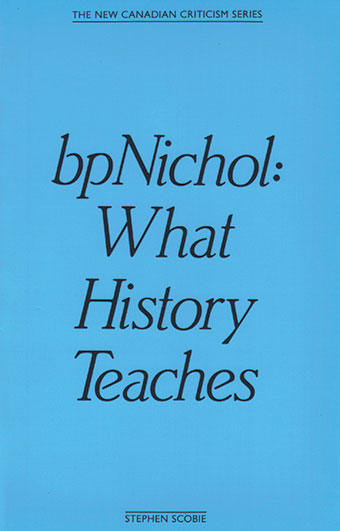
Scobie illuminates bpNichol’s relationship to Dadaism, contemporary French literary theory, and the writing of Gertrude Stein, and argues strongly for Nichol’s importance as a writer of fiction.
Other titles in The New Canadian Criticism Series:
- ABC of Reading TRG
- Timothy Findley and the Aesthetics of Fascism
- Michael Ondaatje: Word, Image, Imagination
- Margaret Atwood: A Feminist Poetics
- George Bowering: Bright Circles of Colour
Born in Scotland, Stephen Scobie is a critic and a poet who won the Governor General’s Award for Poetry in 1980 and the Prix Gabrielle Roy for Canadian Criticism in 1986. A founding editor of Longspoon Press, his literary criticism includes books on bpNichol, Leonard Cohen, Sheila Watson and Bob Dylan. His first book of poetry, Stone Poems, was published by Talonbooks in 1974. His critical work bpNichol: What History Teaches, published in 1984 is part of the Talonbooks New Canadian Criticism Series, edited by Frank Davey.
Born in Vancouver, Frank Davey attended the University of British Columbia where he was a co-founder of the avant-garde poetry magazine TISH. Since 1963, he has been the editor-publisher of the poetics journal Open Letter. In addition, he co-founded the world’s first on-line literary magazine, SwiftCurrent in 1984. Davey writes with a unique panache as he examines with humour and irony the ambiguous play of signs in contemporary culture, the popular stories that lie behind it, and the struggles between different identity-based groups in our globalizing society—racial, regional, gender-based, ethnic, economic—that drive this play.
By Stephen Scobie
Born in Scotland, Stephen Scobie is a critic and a poet who won the Governor General’s Award for Poetry in 1980 and the Prix Gabrielle Roy for Canadian Criticism in 1986. A founding editor of Longspoon Press, his literary criticism includes books on bpNichol, Leonard Cohen, Sheila Watson and Bob Dylan. His first book of poetry, Stone Poems, was published by Talonbooks in 1974. His critical work bpNichol: What History Teaches, published in 1984 is part of the Talonbooks New Canadian Criticism Series, edited by Frank Davey.
By Stephen Scobie
Scobie illuminates bpNichol’s relationship to Dadaism, contemporary French literary theory, and the writing of Gertrude Stein, and argues strongly for Nichol’s importance as a writer of fiction.Other titles in The New Canadian Criticism Series: ABC of Reading TRG Timothy Findley and the Aesthetics of Fascism Michael Ondaatje: Word, Image, Imagination…
$13.95
Paperback / softback
ISBN:
9780889222205
Pages:154
Dimensions: 9" x 6" x 0.5"
Pub. Date:
January 1 1984
Non-Fiction / LIT004080
By bp Nichol
Edited by Carl Peters
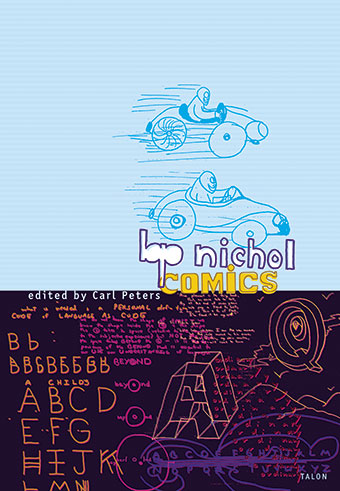
The scope, innovation and depth (down to the heart) of bpNichol’s writing makes him one of the most important writers in English of the 20th century. He is widely known for his research into genres as diverse as the lyric, the long poem, sound poetry, concrete poetry, critical theory and…
$29.95
Paperback / softback
ISBN:
9780889224483
Pages:320
Dimensions: 9" x 6" x 0.75"
Pub. Date:
January 1 1984
Non-Fiction / LIT004080

Useful Links
Latest Bluesky Posts
Phone: (604) 444-4889
Outside Vancouver: 1 888 445-4176
Fax: (604) 444-4119
Website: www.talonbooks.com
Email: info@talonbooks.com
Talonbooks gratefully acknowledges the unceded, Traditional, and Ancestral Territories of the Coast Salish Peoples, including those of the xʷməθkʷəy̓əm, Sḵwx̱wú7mesh, and səlilwətaɬ First Nations, on which we are privileged to live, work, read, and write.
Talonbooks is thankful for the financial support of the Canada Council for the Arts, the Government of Canada through the Canada Book Fund, and the Province of British Columbia through the British Columbia Arts Council and the Book Publishing Tax Credit.




Copyright Talonbooks 1963–2026
If you have any questions or comments about this website, contact the webmaster.